Archive for March, 2004

Racist vandalism at the Claremont Colleges

Wednesday, March 10th, 2004

From a thread on cmcstudents, hyperlinks added:

[Tuesday], at 4pm, there was a community forum at CMC's Athaneum called "Hate Speech Versus Free Speech". During this, Professor Dunn made statements in support of minority groups and against hate speech, actions and perpetrators of such. She criticized the recent incidents* on the 5 C's [Claremont Colleges]. Sometime between 4pm-8pm (so right after her speech), her car was found vandalized in the parking lot on 6th and Amherst, all tires slashed, windows smashed, and spraypainted were the words, "nigger lover," "bitch," "SHUT UP," and "kike whore." The Claremont Police classified it as a hate crime.

WTF.

*the recent incidents had varying severity and racial motivation:

  • Four students stole and burned a cross during winter break. (This incident divided students in several ways.)
  • A club's scavenger hunt included the item "Photograph yourself with 10 Asian students".
  • Someone took a green marker and wrote "NIGGER" next to George Washington Carver's picture in a calendar. The calendar was on a hallway bulletin board at CMC.
  • Scripps students put up posts such as "'Nigger.' Renewing old hate in the new millennium." and "'Nigger.' This is the ignorance that a $35,000 a year education produces." Some students didn't see the satire indended by the creators of the posters.
How to report a security hole to Microsoft

Wednesday, March 10th, 2004

Hixie helped me report a security hole to Opera. Then Hixie and his friends at the W3C Technical Plenary tried to help me report it to Microsoft, offering these suggestions:

  • "There's probably a form on microsoft.com/ie."
  • "You report it to cnet."
  • "You break into Microsoft's systems using the exploit, and insert the bug into their bug system. Since you can only do that with security bugs, that filters out the non-security ones."

I think I reported the bug to Microsoft successfully. The language on Microsoft's form ("enchancement suggestion" and "wish" rather than "bug report") was discouraging, but I did get to check a box labeled "Security".

NeonGecko’s demo

Tuesday, March 9th, 2004

The NeonGecko Clinic team demonstrated their forum post categorization software with two examples. It correctly classified

I have a feisty persian. How can I save the furniture?

as "cats" (91%) and

I have a feisty Persian Gulf crisis. How can I save the future?

as "politics" (84%) and "bush" (9%). If you mix the two examples, it gets confused, as it should.

Experience Google’s new look

Saturday, March 6th, 2004

Google has been testing a new look with a small percent of visitors. I wrote a bookmarklet that lets you make Google show you the new look:

toggle google look

(Drag it to your bookmarks bar, visit google.com, and click on the bookmark.)

It works by changing the ID in your Google cookie to 102c51875a8839e9, the ID of one of the visitors Google randomly selected to test the new look. If your ID is already 102c51875a8839e9, it sets it 0000000000000000 (anonymous), letting you switch between the old and new looks quickly. Since the bookmarklet only changes the ID part of the cookie, it preserves your settings, such as the number of results per page.

Thanks to jcurious for pointing out the Neowin thread in which "poind" posted the ID from his Google cookie.

Update March 28, 2004: Google is now showing the new look by default. The bookmarklet no longer has any visible effect.

Update January 27, 2005: iMilly has created a modified version of this bookmarklet to anonymize your Google cookie.

Illusory contour in an advertisement

Saturday, March 6th, 2004

The woman in this clever clothing advertisement is as convincing as the white triangle in the Kanizsa Triangle illusion.

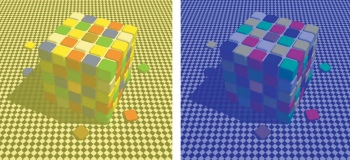
Color-constancy illusion

Friday, March 5th, 2004

Michelle, Lauren, and I stumbled on a strong illusion last night. It's similar to the checkerboard illusion but involves color rather than just shades of gray.

The "blue" tiles on top of the left cube and the "yellow" tiles on top of the right cube are actually the same shade of gray.

Articles that talk about this illusion: American Scientist: Why We See What We Do and Discover Magazine: Sensory Reflexes. (The authors of the American Scientist article wrote a book with the same name.)

Berkeley's dilemma (as described by the American Scientist article) reminds me of Quine's Gavagai problem in the acquisition of language. Berkeley's dilemma is that retinal images are inherently ambiguous -- for example, there's no difference in the retinal image created by a large object at medium distance and a small object at a large distance. In the Gavagai problem, an island native points to a rabbit and says "gavagai". Do you interpret "gavagai" as "rabbit", "there goes a rabbit", "white", "animal", "hopping", "it's a nice day", "cute", "lunch", or something else?

Both Berkeley's dilemma and the Gavagai problem are problems of infinite ambiguity. Humans have clever heuristics for dealing with both problems. Examples include color constancy and overestimation of acute angles in visual perception, and the whole-object, taxonomic, and mutual-exclusivity assumptions children use to interpret new nouns.

Synesthesia

Wednesday, March 3rd, 2004

My friend Michelle sees English letters and some Chinese characters as having colors. She doesn't like sites about letter-color synesthesia because they always get the colors of the letters wrong.