Bears, you’re on notice.
October 20th, 2006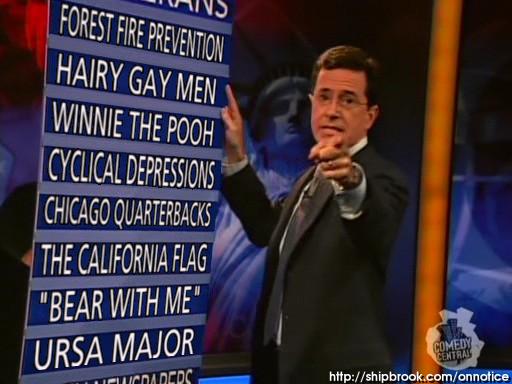
I made this using the On Notice Board Generator.
I made this using the On Notice Board Generator.
Cory Doctorow gave a keynote at ToorCon about DRM. During the Q&A, an audience member asked him to give additional comments on the infinite copyright situation. Cory's answer focused not on the effects on the general public, but on the effects on artists.
It's bad news because for most of us, 45 years after our work is created, a hundred years after our work is created ... figuring out who you need to talk to before you can re-use that work -- before you can bring it back, archive it, or put it back in the stream of commerce, make a new work from it -- is almost impossible, and certainly costs more than you'll ever hope to earn from those works. As a result, the works languish. You might have a piece that would be interesting to use in your new transformative work, but figuring out who you need to pay, let alone paying them, costs more than you'll ever be able to earn back from it.
What that means is that the library is burning in slow motion. All that film ... is turning to slime and we can't bring it back. [As long the early Mickey Mouse shorts] remain in copyright, all those other works disappear. It's a kind of radical denuding of the marketplace.
There are a lot of bad things you can do to artists: you can plagiarize us, you can rip us off, you can leave us to die in penury, you can write nasty things about our books on Amazon. But of all the things that you can do to artists that horrify artists, I think that the one for which we reserve a special creeping horror is the spectacle of the mountain of books on fire. It's being removed from the public eye ... it's being forgotten by history.
Back in February, Sprint invited me to become a Sprint Ambassador: they gave me a SPH-A920 phone and six months of free service, hoping that I'd give them useful feedback and/or blog about it. Here's some of the feedback I sent to Sprint:
I loved being able to give my laptop access the Internet anywhere I had phone service. For example, the day after my son was born, I was able to research potential middle names while we were still at the hospital. I also used this feature to get some work done during boring parts of a family vacation. (This feature was free for me because I was part of the Ambassador program; I don't think it's free for other Sprint customers.)
Having an extra phone was surprisingly useful. I was able to lend my old phone to my girlfriend and talk with her for more than two minutes a day without worrying about her running out of minutes. I later found out that I could have added her to my family's plan for $10/month, but I wouldn't have thought of doing that otherwise.
The phone was better in many ways than my old phone, and it was certainly better than the phone for 4-year-olds Sprint sent to Joel Spolsky. But I still found a lot to be frustrated about with both the phone and the service.
There were some small problems with the "connect your laptop to the Internet" feature. The Windows software is hard to set up; my dad gave up on trying to get it work with his laptop. The fact that the feature works at all with Mac laptops kept secret from users. The phone gives up on the connection too easily when reception is poor, forcing me to click on "Connect" every few minutes. Once this feature works better, I hope Sprint promotes it heavily and stops trying to charge extra for it.
The "VoiceSMS" feature of the SPH-A920 phone works exactly as voicemail should: the messages are stored on my handset so I can listen to them even where reception is poor, I can see a list of messages without listening to a voice menu, I can rewind or fast-forward by 5 seconds by pressing arrow keys, and I can forward a message to my email address. But when someone tries to call me and leave a message, it doesn't become a VoiceSMS. Instead, it goes into the old-school voicemail system that everyone hates because it uses voice menus and makes you memorize shortcuts and surreptitiously deletes your messages after three weeks.
I'd like it if I could keep my phone on when I sleep, so I could respond to family emergencies. But I don't want every illegal telemarketing call, "wrong number" call, or poorly timed "how are you doing" call to wake me up. I want to be able to specify who is allowed to wake me up, and I want them to be greeted with "Jesse is asleep. Press 1 to leave a message or press 2 to wake him up." when they call.
When reception is poor on either end of a conversation, half of the conversation ends up being "I only heard every other word in that sentence" or "Are you still there?", and it takes forever to actually communicate something. This could be made much better by waiting until the entire sentence gets to my phone -- I'd gladly take some lag if it allowed me to actually hear the other person's sentences. I imagine the tricky parts would be figuring out where the breaks are if the other person is in a noisy area, and informing the other person about the lag so they don't confuse my slow responses for conversation pauses that need to be filled. Take some inspiration from the magic of TCP over IP and you could make using phones a lot less aggravating.
I couldn't figure out how to back up my contact list onto my computer. I get the feeling you're intentionally making this difficult in order to prevent customers from switching to other phone service providers. Don't make us sick the FCC on you again; you don't even have the "but that would be hard!" excuse you had with number portability.
The phone takes as long to start up as my computer. Palm handhelds start up quickly; why can't my phone?
Charging extra for each feature (e.g. automated 411, maps and directions, Web access using a browser in the phone, Internet using a nearby laptop, text messaging) is lame. The only charge should be for data transfer, which should be treated in the same way as "minutes". Customers who feel like they can't live without your phone are loyal customers; customers who feel that you tried to rip them off at every turn and barely used the phone's features are not. And I'd think loyal customers who stick with the service and tell their friends about it are worth much more than the revenue from infrequent use of the features.
I don't understand why the SPH-A920 is promoted as a "music phone". I can't plug my ordinary comfy headphones into it, because cell phones use a different type of headphone jack than laptops. I don't want to purchase music a second time through a menu on my phone; I want to sync with my computer and listen to music I own.
Yesterday, at around 4pm, I noticed that the content on squarefree.com was missing, and the main page was an empty directory listing. I ssh'ed to my web server and noticed that the "squarefree.com" directory had been renamed to "squarefree.com_DISABLED_BY_DREAMHOST". Then I checked my email and saw a message from DreamHost support:
Hello,
I just had to disable your site squarefree.com as it's coming under some load and spawning countless php processes that are crashing the webserver. I wasn't able to figure out exactly what's going on, as leaving it up for more than a minute pretty much toasts the server. Please don't re-enable it until you've figured out what's going on, or disabled any possibly problematic php.
Thanks,
James
I jumped into #dreamhost on irc.freenode.net and started looking through my web server logs for suspicious requests. I was expecting to find that my blog had been DDoSed, perhaps by someone trying to leave comment spam. Instead, I found a large number of requests for non-existant files, falling into two categories:
But why would 404 requests create PHP processes? Due to a recent change in WordPress, Apache was directing each 404 request to WordPress. WordPress used to put detailed rules in .htaccess -- for example, it would ask Apache to direct requests for http://www.squarefree.com/2005/ to WordPress using RewriteRule ^([0-9]{4})/?$. But newer versions of WordPress instead ask Apache to send it all requests for nonexistent files. I imagine this puts less strain on Apache when a site uses lots of WordPress Pages, but it hurts when a site gets lots of 404 requests. Several months ago, I had instructed WordPress to serve my custom 404 page for these requests, but WordPress still had to do a lot of work to determine that the requests should be treated as 404s.
Once I realized what had happened, and determined that reconfiguring WordPress would be difficult, I did what I could to reduce the number of 404 requests WordPress would have to handle. I created a tiny favicon.ico file so those requests wouldn't be 404s, and I moved the Real-time HTML Editor onto its own subdomain so WordPress wouldn't handle the 404s it causes. My site was only down for 40 minutes, with the Real-time HTML Editor down a little longer while I waited for the new subdomain's DNS to propagate.
Some things DreamHost could have done better:
Some things DreamHost did right:
If anyone is wondering: yes, I still love DreamHost.
Following Winamp, Mozilla plans to adopt Fibonacci version numbers for Firefox and Thunderbird. The move is intended to help Firefox catch up with Internet Explorer, currently at version 6, and Opera, currently at version 9.
Firefox's previous version numbers, 1 and 1.5, as well as the versions currently being worked on, 2 and 3, fit into the new scheme perfectly. Mozilla CTO Brendan Eich promised to update the Mozilla Roadmap as soon as he finishes implementing JavaScript 1.7 and finalizing the version number for what was previously planned as JavaScript 2.
Firefox user interface designer Mike Beltzner said "Firefox is all about an intuitive and natural user interface, and the Fibonacci sequence is a perfect expression of nature's expression of order and beauty."
"It's got nothing at all to do with horning on on Dan Brown's success with the Da Vinci Code," added Beltzner.
Apple declined to comment as to whether Safari, currently at version 2, would follow. It did, however, threaten to sue a rumor site editor who wrote that Apple would use only powers of two as Safari version numbers.
Firefox 2, which adds spell-checking and scam protection, is slated for a September 2006 release. Firefox 3, which will add a new bookmark system and bring Acid 2 compliance, is planned for a mid-2007 release. Specific plans for Firefox 5 have not yet been announced.
Joost de Valk (aka AlthA) is hosting a CSS3 contest this month. One way to enter is to submit a patch adding a CSS3 feature to Gecko (Firefox) or WebKit (Safari), and get it checked in. For CSS3 features whose specifications are still subject to change, implementations that use a browser prefix (e.g. "-moz-") are acceptable.
Today's Mac OS X security update includes a fix for a Safari/WebKit security hole I reported :)
Description: A maliciously-crafted HTML document could cause a previously deallocated object to be accessed. This may lead to an application crash or arbitrary code execution. This update addresses the issue by properly handling such documents. Credit to Jesse Ruderman of Mozilla Corporation for reporting this issue.
The irc.mozilla.org quote database, which I helped start, now has over 1000 quotes! Coincidentally, the 1000th quote happens to contain the number 1000.


